yixinxuxyz
Tetrahedral numbers
Tetrahedral numbers are essentially the 3-dimensional version of triangular numbers. To construct them, imagine stacking balls in a triangular pyramid, as shown:
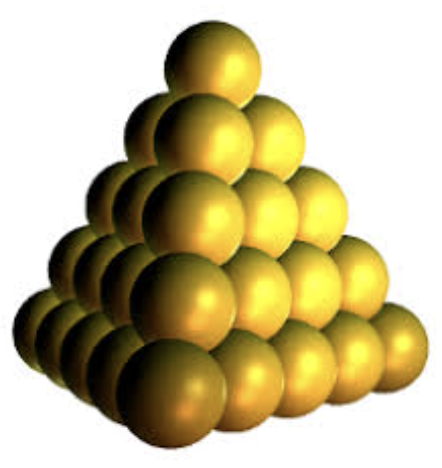
In fact, we can directly construct tetrahedral numbers as a sum of triangular numbers! (Visulize this as making the first $n$ triangular numbers using balls, then stacking each of those ball-triagles on top of each other). Let the $n$-th tetrahedral and $n$-th triangular numbers be denoted as $V_n$ and $T_n$, respectively. Then it follows
Thm 1.1: $V_n=T_n+T_{n-1}+\dots+T_2+T_1$ for $n\in\mathbb{N}$
Then clearly it follows,
Thm 1.2: $V_n=T_n+V_{n-1}$ for $n\in\mathbb{N}$
Proof: $V_n=T_n+T_{n-1}+\dots+T_2+T_1=T_n+(T_{n-1}+\dots+T_2+T_1)=T_n+V_{n-1}.$ $\square$
Next, we show the general formula for tetrahedral numbers.
Thm 2: $V_n=\dfrac{(n)(n+1)(n+2)}{6}$ for $n\in\mathbb{N}$
Proof 1: We proceed with weak induction:
Base Case: $n=1$. Indeed, $V_1=\frac{1\cdot2\cdot3}{6}=1$, so the base case holds.
Inductive Step: Suppose $n=k-1$ were true; we are now to prove $n=k$, which is equivalent to the following:
\[V_k=\dfrac{(k)(k+1)(k+2)}{6}\]Using (Thm 1.2), we may expand $V_k$:
\[V_{k-1}+T_k=\dfrac{(k)(k+1)(k+2)}{6}\]We know both of these variables in terms of $k$; thus, it suffices to show that
\[\dfrac{(k-1)(k)(k+1)}{6}+\frac{(k)(k+1)}{2}=\dfrac{(k)(k+1)(k+2)}{6}\]Simplify:
\[\begin{gathered} & (k-1)(k)(k+1)+3(k)(k+1)=(k)(k+1)(k+2)\\ & (k-1)+3=(k+2)\\ & k=k \end{gathered}\]which completes the proof. $\square$
You may also have noticed that the formula for tetrahedral numbers looks much like a binomial coefficient. Indeed, we can find another proof using this fact!
Proof 2: It is true by Thm 1.1 that
\[V_n=T_n+T_{n-1}+\dots+T_2+T_1,n\in\mathbb{N}\]It is known the formula for triangular numbers is $T_n=\frac{(n)(n+1)}{2}=\binom{n+1}{2}$; therefore, using the hockey stick identity:
\[\begin{aligned} V_n &= T_n+T_{n-1}+\dots+T_2+T_1\\ &= \binom{n+1}{2}+\binom{n}{2}+\dots+\binom{3}{2}+\binom{2}{2}\\ &= \binom{n+2}{3}\\\ &= \frac{(n)(n+1)(n+2)}{3} \end{aligned}\]as desired. $\blacksquare$