yixinxuxyz
Theorems
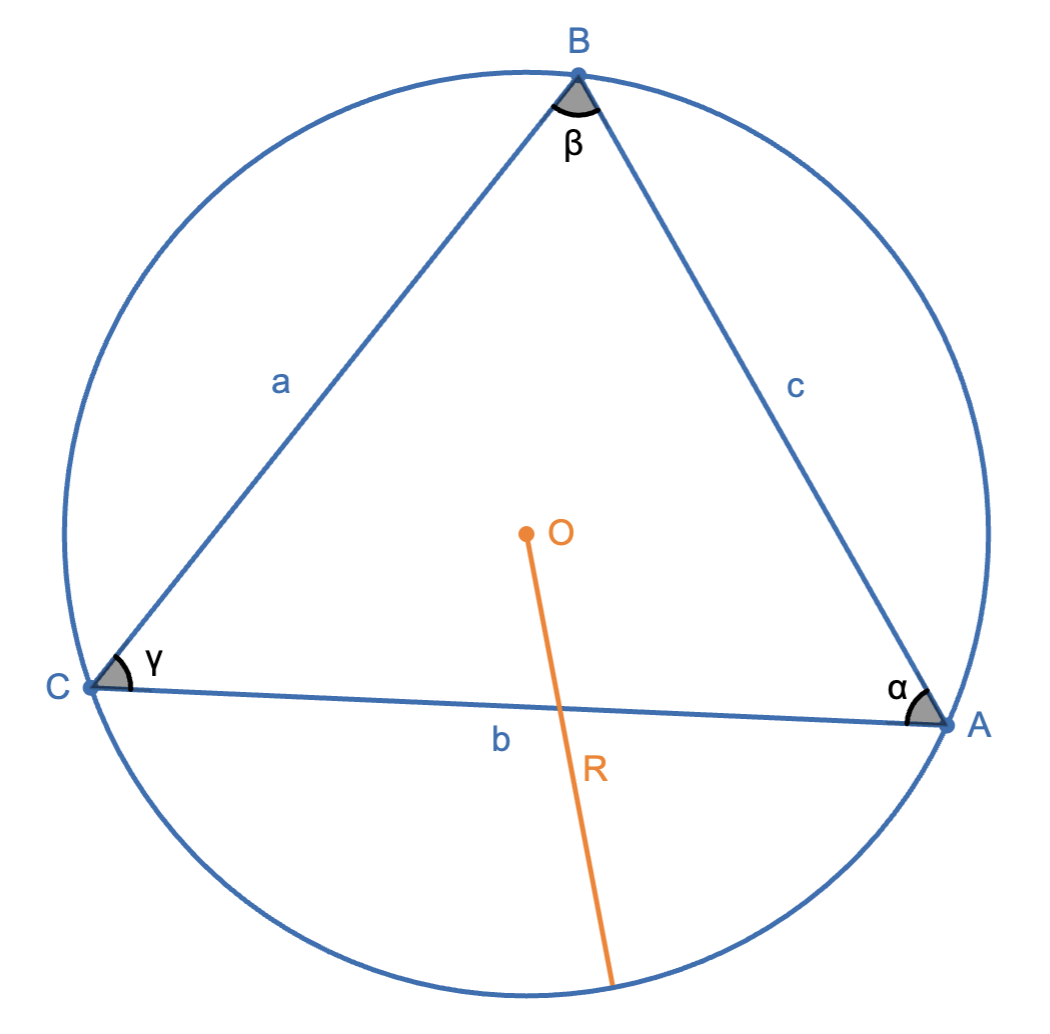
Law of Sines: $\dfrac{a}{\sin\alpha}=\dfrac{b}{\sin\beta}=\dfrac{c}{\sin\gamma}=2R$.
Ratio Lemma: $\dfrac{BD}{DC}=\dfrac{\sin\alpha_1}{\sin\alpha_2}\cdot\dfrac{AB}{AC}$.
Law of Cosines: $c^2=a^2+b^2-2ab\cos C$.
Stewart’s Theorem: $d^2=\dfrac{c^2n+b^2m}{a}-mn$. Alternatively, can be remembered easily using: $man+dad=bmb+cnc\Longleftrightarrow$ “A man and his dad put a bomb in the sink.”
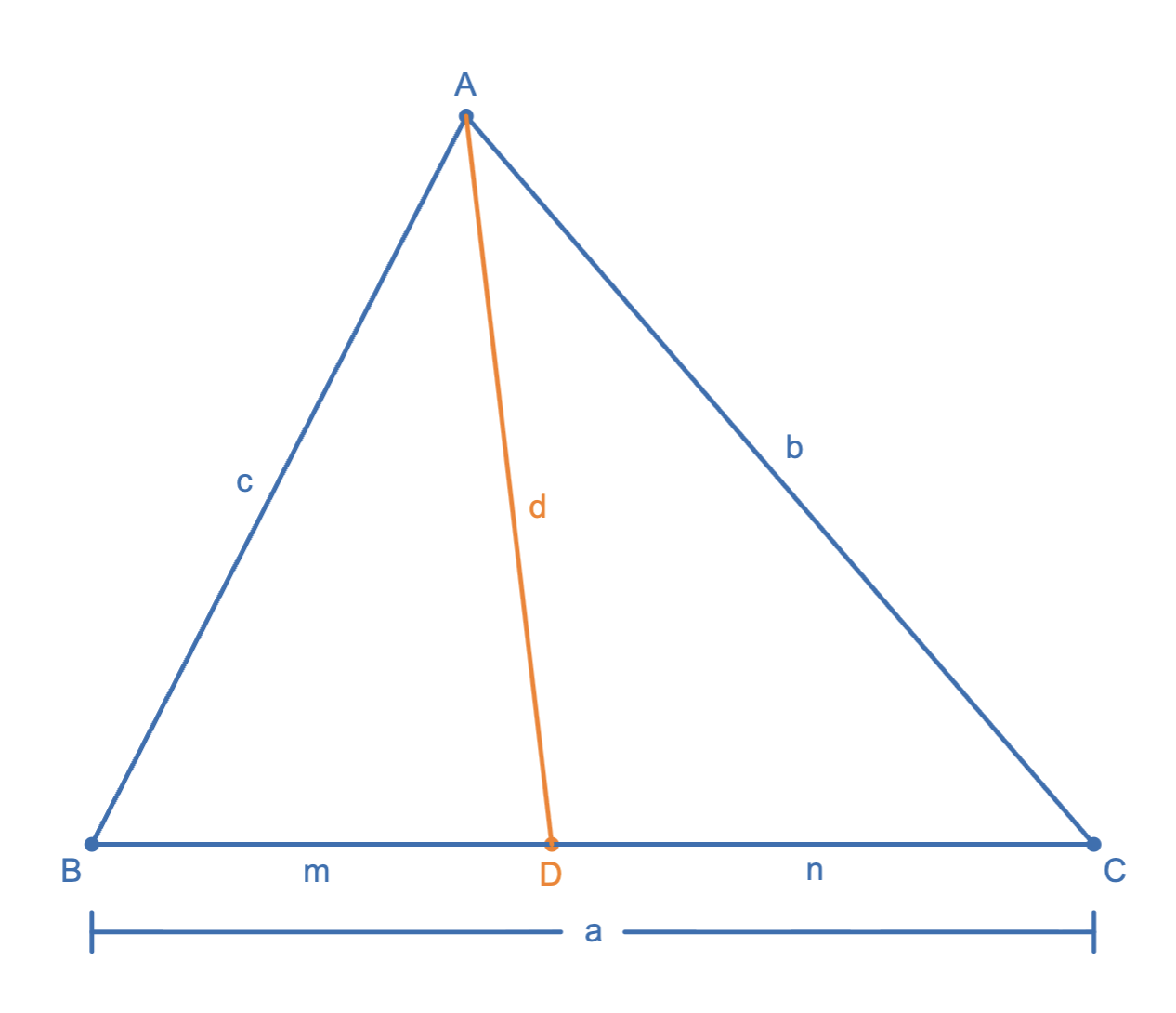
Corr 1: $AD$ is median. Then $d^2=\dfrac{c^2+b^2}{2}-\dfrac{a^2}{4}$. Corr 2: $AD$ is angle bisector. Then $d^2=bc\left(1-\dfrac{a^2}{(b+c)^2}\right)$.
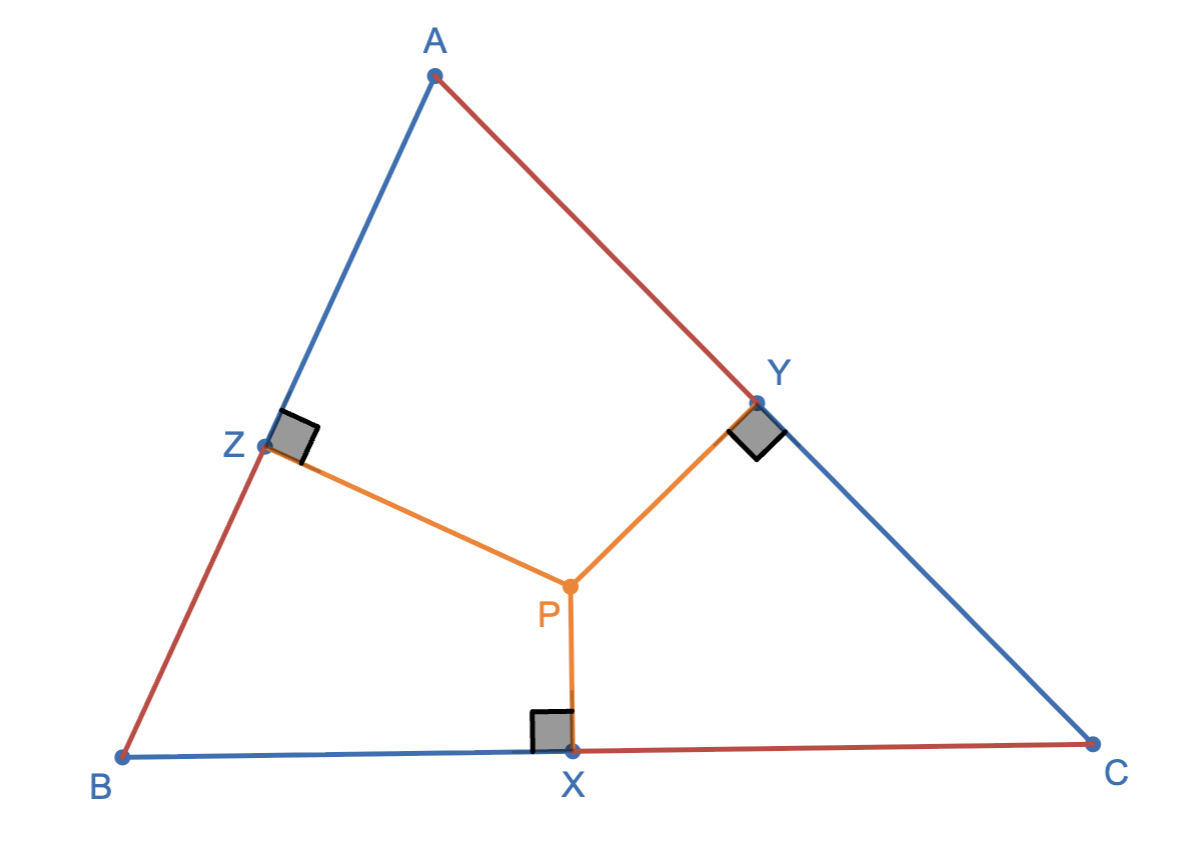
Carnot’s Theorem: $BX^2+CY^2+AZ^2=BZ^2+CX^2+AY^2\Longleftrightarrow\exists \text{ }P, PX\perp BC,PY\perp AC,PZ\perp AB$.
Area of Triangle I: $[ABC]=\dfrac{1}{2}ab\sin C=\dfrac{1}{2}bc\sin A=\dfrac{1}{2}ac\sin B=\dfrac{abc}{4R}$.
**Heron’s formula $[ABC]=\sqrt{s(s-a)(s-b)(s-c)},$ where $s=\dfrac{a+b+c}{2}$.
Corollary: In terms of only side lengths: $[ABC]=\dfrac{1}{4}\sqrt{4a^2b^2-(a^2+b^2-c^2)^2}$.
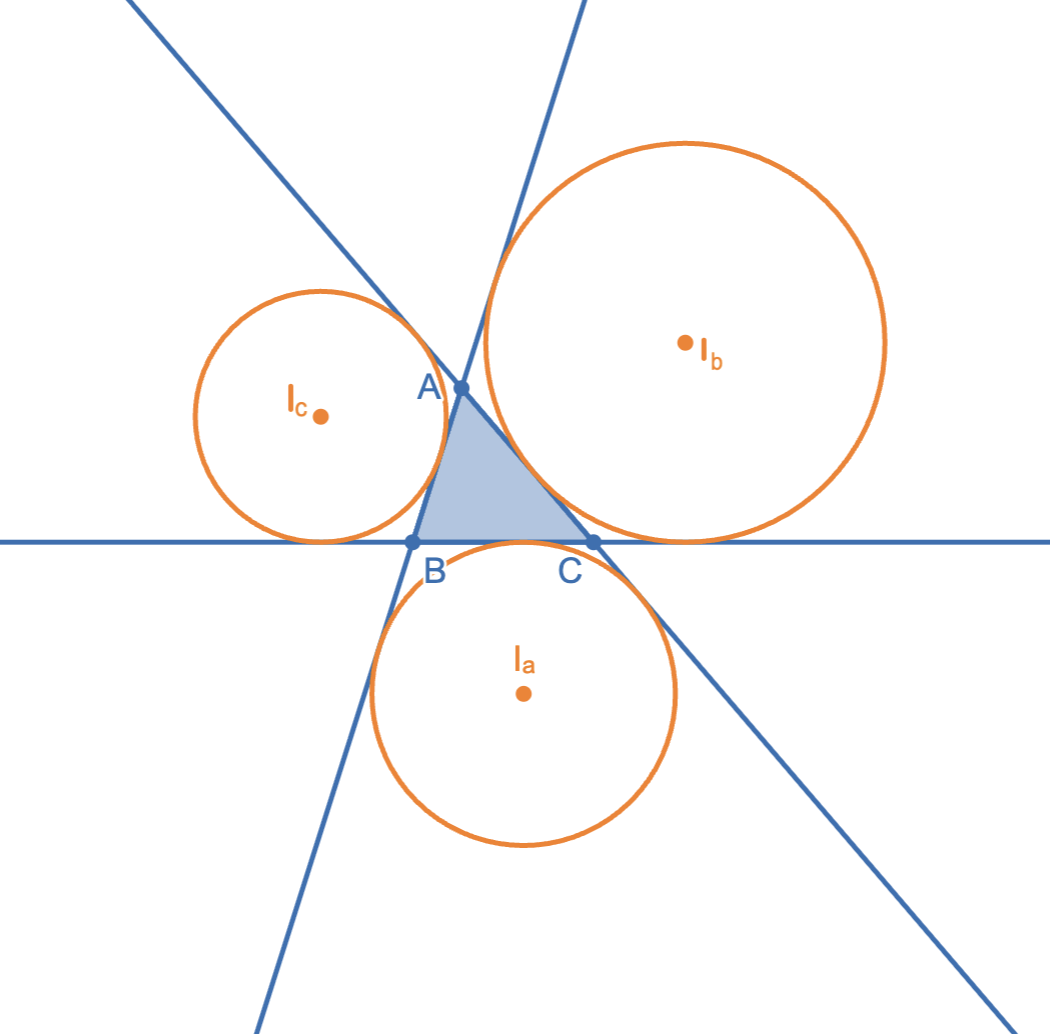
Area of Tiangle II: Let the radii of the excircles tangent to sides $AB$, $BC$, and $AC$ have radius $r_c,r_a,r_b$. Then $[ABC]=r_a(s-a)=r_b(s-b)=r_c(s-c)$, where $s=\frac{a+b+c}{2}$.
Bretschneider’s Formula: $[ABCD]=\sqrt{(s-a)(s-b)(s-c)(s-d)-abcd\cos\left(\dfrac{\angle B+\angle D}{2}\right)}$, where $s=\dfrac{a+b+c+d}{2}$.
Corollary (Brahmagupta’s Formula): If $ABCD$ is cyclic, then $[ABCD]=\sqrt{(s-a)(s-b)(s-c)(s-d)}$ since $\angle B+\angle D=180^\circ$
HM-AM-GM-QM chain: For positive $a_{1,2\dots,n}$:
\[\sqrt{\dfrac{\displaystyle\sum_{i=1}^n a_i^2}{n}}\geq \dfrac{\displaystyle\sum_{i=1}^n a_i}{n}\geq \sqrt[n]{\prod_{i=1}^n a}\geq\dfrac{n}{\displaystyle\sum_{i=1}^n \frac{1}{a_i}}\]with equality $\mathbf{iff}$ $a_1=a_2=\dots=a_n$.
Cauchy-Schwarz: For positive $a_{1,2\dots,n}, b_{1,2\dots,n}$:
\[\left(\sum_{i=1}^n a_i^2\right)\left(\sum_{i=1}^n b_i^2\right)\geq\left(\sum_{i=1}^n a_ib_i\right)^2\]with equality $\mathbf{iff}$ $\dfrac{a_1}{b_1}=\dfrac{a_2}{b_2}=\dots=\dfrac{a_n}{b_n}$.
Ravi’s Substitution: If $a,b,c$ are sides of a triangle, then there always exist positive $x,y,z$ such that:
\[\begin{cases} a=y+z \\ b=x+z \\ c=x+y. \end{cases}\]While not a “theorem,” Ravi’s substitution is often a powerful method to solve strange inequalities.
Euler’s Theorem (In Geometry): In a triangle $ABC$ with incenter $I$ and circumcenter $O$, it is true that:
\[OI^2=R(R-2r)\]Following this, we may also conclude that $R-2r\geq0\Longrightarrow R\geq2r$ (Euler’s Inequality).