yixinxuxyz
2026 YMC Solutions
Answer Key
| 1 E | 6 B | 11 C | 16 E | 21 D |
| 2 C | 7 A | 12 A | 17 D | 22 B |
| 3 C | 8 A | 13 D | 18 E | 23 E |
| 4 C | 9 C | 14 D | 19 D | 24 C |
| 5 E | 10 C | 15 B | 20 A |
Scoring: +4 points for correct, +1 for unaswered, +0 for incorrect. Total points: 96.
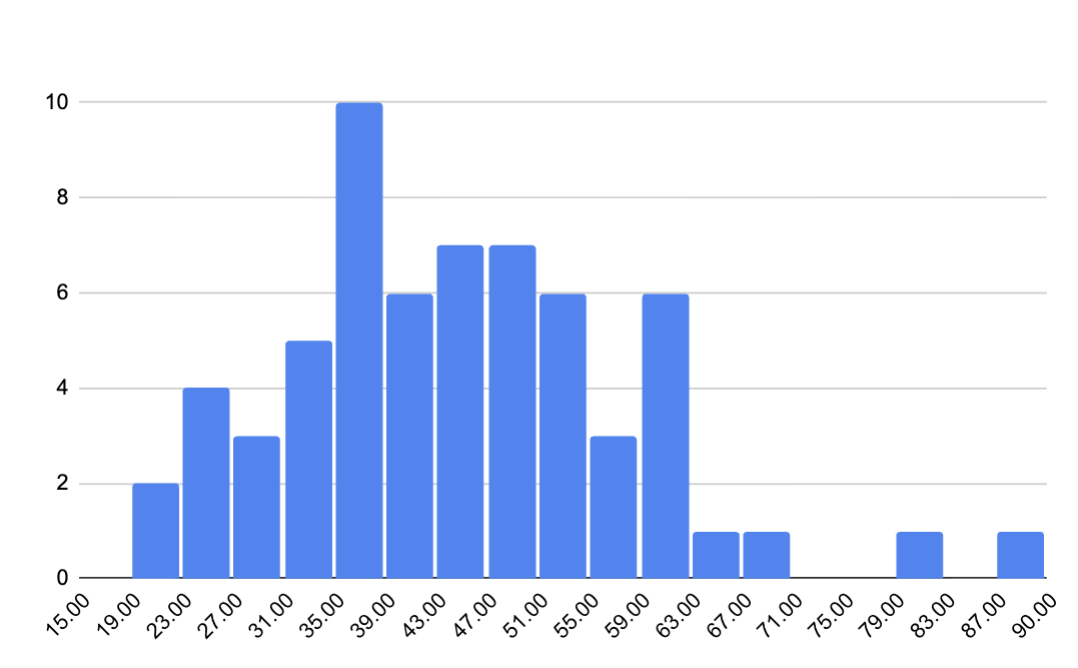
Score Distribution
Problem 1
What is the sum of the positive factors of 2026 (including 1 and itself)?
$\text{(A) } 1015\qquad \text{(B) } 2026\qquad \text{(C) } 2027\qquad \text{(D) } 3041\qquad \text{(E) } 3042$
Solution: We have $2026=2\cdot1013$, (1013 is prime) so the requested sum is
\[1+2+1013+2026=\boxed{\text{(E) } 3042}.\text{ }\square\]Problem 2
Compute the area of a triangle with two sides of length 13 and one side of length 10.
$\text{(A) } 30\qquad \text{(B) } 45\qquad \text{(C) } 60\qquad \text{(D) } 90\qquad \text{(E) } 120$
Solution: By dropping the altitude of the vertex opposite the side of length 10, we can split our triangle into two 5-12-13 right triangles. The area is thus $2\cdot\frac{1}{2}\cdot5\cdot12=\boxed{\text{(C) } 60}$. $\square$
Problem 3
Mehul has 5 distinct textbooks that are to be stacked in a pile. Given that two of the textbooks, English and Math, must be put adjacent to each other, in how many ways can Mehul stack his textbooks?
$\text{(A) } 15\qquad \text{(B) } 24\qquad \text{(C) } 48\qquad \text{(D) } 60\qquad \text{(E) } 120$
Solution: By treating the English and Math textbooks as a singular block, we can effectively calculate the number of arrangements of 4 distinct units (the block and the other 3 books), then arrange the English and Math textbooks within the block. This evaluates to be $4!\cdot2!=\boxed{\text{(C) } 48}$. $\square$
Problem 4
During a stretch of 4 days, the weather forecast shows a 50% chance of rain on each day, independent of the previous. What is the probability it rains for at least 3 days in a row?
$\text{(A) } \frac{1}{16}\qquad \text{(B) } \frac{1}{8}\qquad \text{(C) } \frac{3}{16}\qquad \text{(D) } \frac{1}{4}\qquad \text{(E) } \frac{1}{3}$
Solution: Let a $R$ denote a rainy day, and $D$ denote a dry day. The satisfactory sequences of four letters are thus $RRRD,DRRR$, and $RRRR$. The probability is thus $\dfrac{3}{2^4}=\boxed{\text{(C) } \frac{3}{16}}$. $\square$
Problem 5
Let the 2 distinct solutions to $x^2-5x-10=0$ be $p$ and $q$. Then the value of $p^2+q^2$ is
$\text{(A) } 20\qquad \text{(B) } 25\qquad \text{(C) } 30\qquad \text{(D) } 40\qquad \text{(E) } 45$
Solution: Note that $p^2+q^2=(p+q)^2-2pq$. By Vieta’s relations, we obtain
\[\begin{cases} p+q=5\\ pq=-10 \end{cases}\]thus yielding $p^2+q^2=5^2-2(-10)=\boxed{\text{(E) } 45}$. $\square$
Problem 6
The graph of $x^{2}y^{2}-x^{2}-y^{2}+1=0$ is best described as:
$\begin{aligned} &\text{(A) Two concentric circles centered at the origin.} \\ &\text{(B) Two pairs of two parallel lines that form a square.}\\ &\text{(C) 3 lines that form an isosceles right triangle.} \\ &\text{(D) 2 parabolas, where one opens upward and one opens downward.} \\ &\text{(E) No such } (x,y) \text{ exist.} \end{aligned}$
Solution: We can factor this into $(x^2-1)(y^2-1)=(x-1)(x+1)(y-1)(y+1)=0$. This implies that any of $x-1,x+1,y-1,y+1$ is equal to 0, which results in the 4 lines $x=1,x=-1,y=1,y=-1$ respectively; these form a square $\Longrightarrow \boxed{\text{B}}$. $\square$
Problem 7
Avi and Jason have the following conversation regarding Jason’s favorite number:
$\begin{aligned} &\text{Avi: “Is your favorite number greater than 50?”} \\ &\text{Jason: “Yes, and less than 80.”} \\ &\text{Avi: “Is it divisible by 2?”} \\ &\text{Jason: “No.”} \\ &\text{Avi: “Is it divisible by 5?”} \\ &\text{Jason: “Also no.”} \\ &\text{Avi: “Ah — is it a prime number?”} \\ &\text{Jason: “Yes. Furthermore, the sum of the digits of my number is prime.”} \\ &\text{Avi: “There are still two possible values…”} \\ &\text{Jason: “It’s the larger choice.”} \\ \end{aligned}$
What is the positive difference between the two digits of Jason’s favorite number?
$\text{(A) } 1\qquad \text{(B) } 2\qquad \text{(C) } 3\qquad \text{(D) } 4\qquad \text{(E) } 5$
Solution: The only prime numbers between 50 and 80 are $53, 59, 61, 67, 71, 73, \text{and } 79$. Computing the sums of the digits, we see that the two satisfactory results are 61 and 67. Choosing the larger, we see that the requested difference is $7-6=\boxed{\text{(A) } 1}$. $\square$
Problem 8
Regular octagon $TINGSHUN’$ has side length $\sqrt{2}$. Compute the area of pentagon $STING$.
$\text{(A) } 2+2\sqrt{2} \qquad \text{(B) } 4+4\sqrt{2}\qquad \text{(C) } 2\sqrt{2}\qquad \text{(D) } 8\qquad \text{(E) } 16$
Solution: $STING$ is the pentagon formed by splitting the regular octagon $TINGSHUN’$ through its center into two congruent pieces. Using the formula for the area of a regular octagon we see that $A=2(1+\sqrt{2})a^2=4(1+\sqrt{2})\Longrightarrow [STING]=\frac{A}{2}=\boxed{\text{(A) }2+2\sqrt{2}}$. $\square$
Problem 9
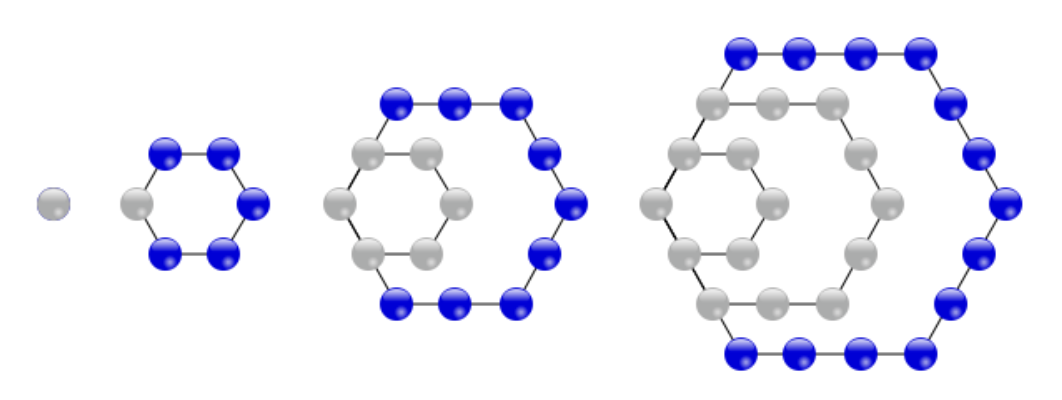
The cornered hexagonal numbers are the numbers formed by a hexagonal formation arrangement of dots in the plane. The first four terms in the sequence are shown below:
What is the sum of the values of the first 7 cornered hexagonal numbers (starting from 1)?
$\text{(A) 161} \qquad \text{(B) 251} \qquad \text{(C) 252} \qquad \text{(D) 371} \qquad \text{(E) 372} $
Solution: Let $H_n$ denote the $n$-th cornered hexagonal number. Notice that in the first term, there is 1 row and 1 dot in each row. In the second term, there are 3 rows and 2 dots in each row. In the third term, there are 5 rows and 3 dots in each row. In general, the $n$-th term has $2n-1$ rows and $n$ dots in each row, so that $H_n=(2n-1)(n)$. Thus, we find that the required sum is
\[1\cdot1+3\cdot2+5\cdot3+7\cdot4+9\cdot5+11\cdot6+13\cdot7=\boxed{\text{(C) }252}.\text{ }\square\]Problem 10
Consider the equation $4^{4^x}=2^{2^y}$. Which of the following is necessarily true in $x$ and $y$?
$\text{(A) } y=2x\qquad \text{(B) } y=4x\qquad \text{(C) } y=2x+1\qquad \text{(D) } y=x+2\qquad \text{(E) } y=2^x$
Solution: We may simplify in the following manner:
\[\begin{aligned} 4^{4^x}&=2^{2^y}\\ (2^{2})^{(2^{2x})}&=2^{2^y}\\ 2^{2\cdot(2^{2x})}&=2^{2^y}\\ 2^{2^{2x+1}}&=2^{2^y}\\ 2x+1&=y \end{aligned}\]Thus the correct answer is $\boxed{\text{C}}$. $\square$
Problem 11
For how many real values of $a$ does \(\Big\vert x-\big\vert x-\vert ax\vert\big\vert\Big\vert =0\) have infinitely many real solutions?
$\text{(A) } 0\qquad \text{(B) } 2\qquad \text{(C) } 3\qquad \text{(D) } 4\qquad \text{(E) infinitely many} $
Solution: For $\Big\vert x-\big\vert x-\vert ax\vert\big\vert\Big\vert =0$ to have infinitely many solution, there must exist an infinite set of $x$ such that $\big\vert x-\vert ax\vert\big\vert=x$.
- If $x-\vert ax\vert=x$ for infinitely many $x$, then $a=0$
- If $x-\vert ax\vert=-x$ for infinitely many $x$ , then $a=\pm2$
Both hold only for $x>0$. Thus, there are $\boxed{\text{(C) }3}$ real $a$. $\square$
Problem 12
On my biology final, each of the 90 problems are multiple choice, with 4 answer choices and exactly one correct answer. Suppose I answer $n$ questions correctly and guess the rest at random. What is the minimum integer value of $n$ such that the expected value of my score is at least an A? (An A is defined to be any percentage score greater than or equal to 92.5%.)
$\text{(A) } 81\qquad \text{(B) } 82\qquad \text{(C) } 83\qquad \text{(D) } 84\qquad \text{(E) } 85$
Solution: I am expected to get correct one-fourth of the questions I guess. Then we have
\[\begin{aligned} n+\frac{1}{4}(90-n)&\geq92.5\% \cdot 90\\ &= 83.25\\ 4n+90-n&\geq 333\\ n+30&\geq 111\\ n&\geq\boxed{\text{(A) } 81} .\quad\square \end{aligned}\]Problem 13
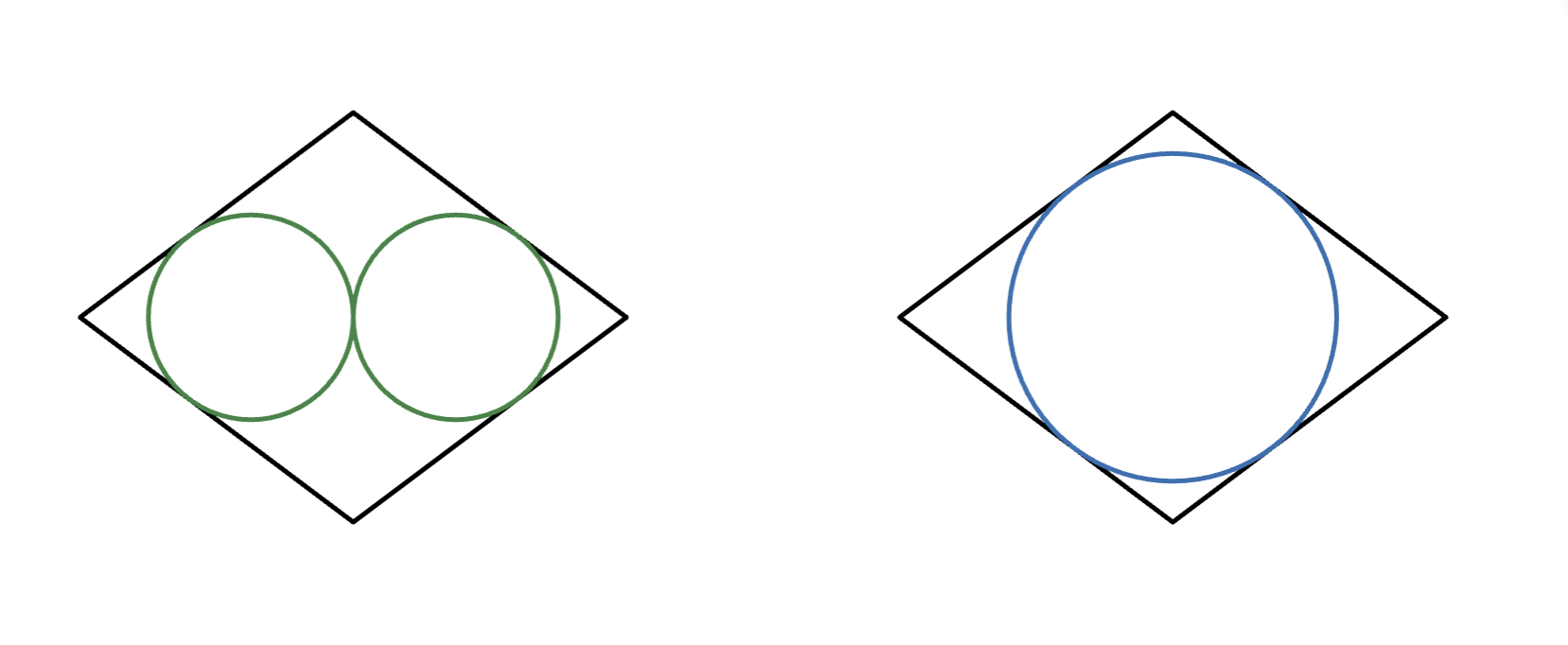
In each of the below diagrams, we have a rhombus with diagonals of length 6 and 8. In the first diagram, two congruent circles are constructed externally tangent to each other and tangent to two sides each; in the second diagram, one large circle is placed tangent to all four sides.
Let the combined area of the two circles in the first diagram be $A$, and let the area of the circle in the second diagram be $B$. Compute $\frac{B}{A}$.
$\text{(A) } \dfrac{25}{32}\qquad \text{(B) } \dfrac{25}{64}\qquad \text{(C) } \dfrac{64}{25}\qquad \text{(D) } \dfrac{32}{25}\qquad \text{(E) } 1$
Solution: Recall that the area of a polygon is equal to the product of its semiperimeter and its inradius (if it exists).
By splitting the first rhombus into two triangles along its shorter diagonal, we obtain two triangles with sides 5, 5, and 6; their incircles are the two green cricles. Each triangle has area 12 and semiperimeter 8, so the radius of each green circle is $\frac{3}{2}\Longrightarrow A=2\cdot\frac{3}{2}^2\cdot\pi=\frac{9}{2}\pi$.
Similarly, the semiperimeter of the right rhombus is 10, while its area is 24. This means the radius of the blue circle is $\frac{24}{10}=\frac{12}{5}\Longrightarrow B=\frac{144}{25}\pi$ Evaluating,
\[\dfrac{B}{A}=\dfrac{144}{25}\cdot\dfrac{2}{9}=\boxed{\text{(D) }\frac{32}{25}}.\quad\square\]Problem 14
(Proposed by Tingxuan Liu) Tingxuan is a professional food critic. Today she is eating 370 mango flavored desserts. The first section includes 70 cheesecakes and the second section consists of 300 smoothies. Tingxuan eats at a constant speed for both sections, but her speed at the smoothie section is 40 “items” per hour faster than her speed at the cheesecake section, and the time she takes at the cheesecake section is exactly half the time she takes on the smoothie section. What is her average eating speed on the smoothie section (in smoothies per hour)?
$\text{(A) } \dfrac{280}{23}\qquad \text{(B) } 35\qquad \text{(C) } \dfrac{1200}{23}\qquad \text{(D) } 75\qquad \text{(E) } 115$
Solution: First, let us acknowledge that Tingxuan definitely has diabetes. Next, suppose were speed on the smoothie section is $k$ items per hour; this means that she ate $k-40$ cheescakes per hour in the first half of the critique. We can set up the simple equation:
\[2\cdot\frac{70}{k-40}=\frac{300}{k}\]Solving this we get $14k=30k-1200\Longrightarrow k=\boxed{\text{(D) }75}$. $\square$
Problem 15
Consider $\triangle ABC$; denote the midpoint of $AB$ as $M$ and the point $N$ as the point on side $BC$ (that is, between $B$ and $C$) where $CN:CB=k$. Let the intersection of $AN$ and $CM$ be $P$; if $CP=PM$, then the value of $k$ is equal to ___.
$\text{(A) } 1:2\qquad \text{(B) } 1:3\qquad \text{(C) } 2:3\qquad \text{(D) } 1:4\qquad \text{(E) } 3$
Solution:
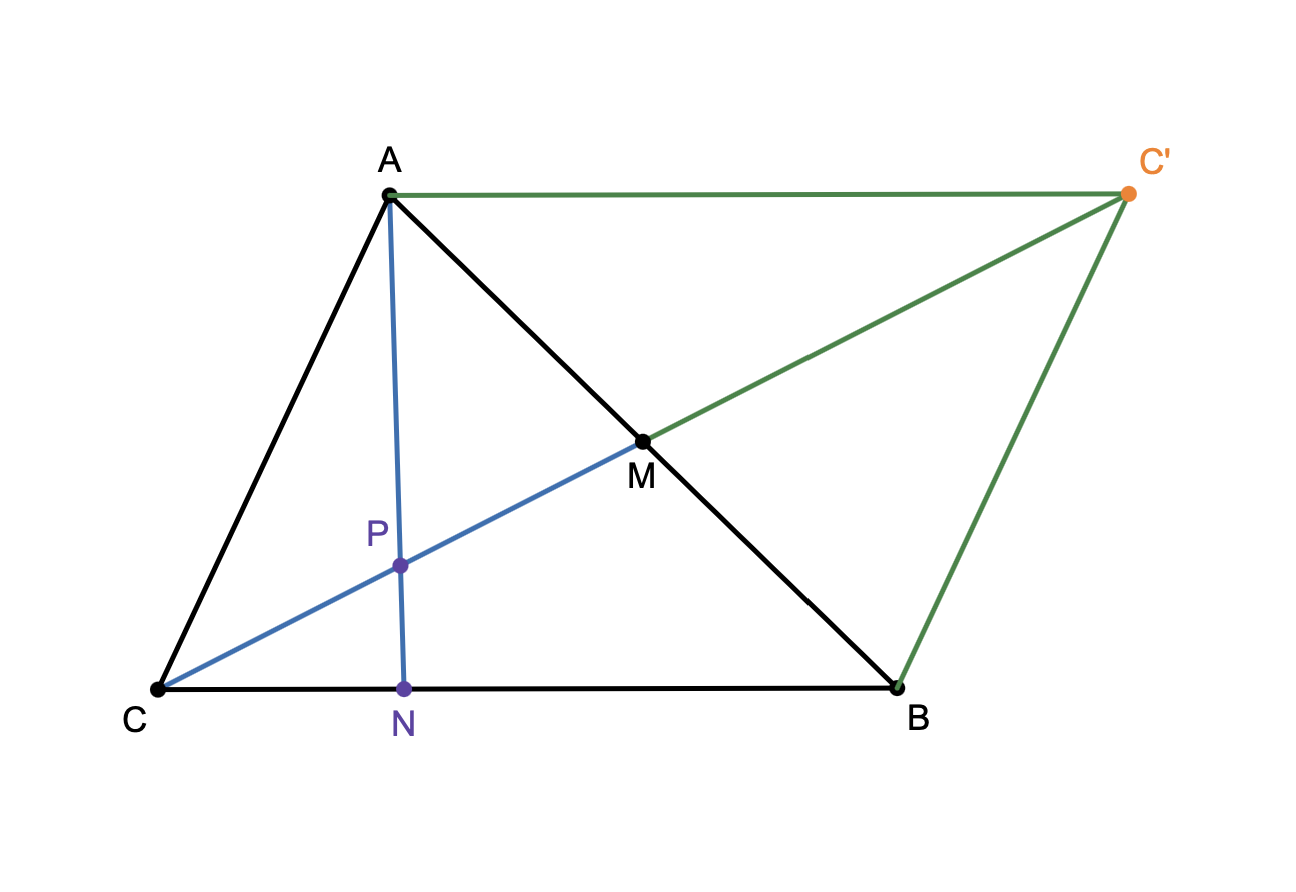
Reflect $C$ over $M$ to get $C’$. It is clear that $ACBC’$ is a parallelogram. Also, since $2CP=CM$ and $CC’=2CM$, $CC’=4CP\Longrightarrow CP:C’P=1:3$. Also, since $\triangle APC’\sim \triangle NPC$, $CN:AC’=CP:C’P=1:3\Longrightarrow CN:NB=\boxed{\text{(A) } 1:2}$. $\square$
Problem 16
Let $\gcd(L)$ and $\operatorname{lcm}(L)$ be the greatest common divisor and least common multiple functions respectively. Which of the following statements are always true for positive integers $a,b,c$?
| Item | Equation |
|---|---|
| I. | $\gcd(a,b,c)=\gcd[\gcd(a,b),\gcd(b,c)]$ |
| II. | $ab=\gcd(a,b)\cdot\operatorname{lcm}(a,b)$ |
| III. | $\gcd(a^2,b^2)=[\gcd(a,b)]^2$ |
$\begin{aligned}
&\text{(A) I only} \qquad
\text{(B) II only} \qquad
\text{(C) I and II only} \
&\text{(D) II and III only} \qquad
\text{(E) I, II and III}
\end{aligned}$
Solution: The answer is $\boxed{E}$. The first statement is a fact which reflects the associative property of $\gcd()$. The second is also a fact, and this can be shown as follows:
Assume $\gcd(a,b)=d\Longrightarrow a=dx,b=dy$ for some relatively prime $x,y$. Then, $\operatorname{lcm}(a,b)=dxy$. The proof is completed as $dx\cdot dy=d\cdot dxy$.
For the last one, we can also assume $\gcd(a,b)=d\Longrightarrow a=dx,b=dy$ for some relatively prime $x,y$. Then, $\gcd(a^2,b^2)=d^2$ because $\gcd(x^2,y^2)=1$, and the proof is completed. $\square$
Problem 17
Consider the set of points on the coordinate plane $S: y=\sqrt{-x^{2}+4x}$. There exist real values of $a$ such that $S$ and $y=x+a$ have exactly one intersection; furthermore, the set of possible values of $a$ can be represented as $a\in [m,n) \text{ or } a=\sqrt{p}-q$ for integers $m,n,p,q$. Compute $m+n+p+q$. (The $\in$ symbol denotes “is in”.)
$\text{(A) -6} \qquad \text{(B) -4} \qquad \text{(C) 2} \qquad \text{(D) 6} \qquad \text{(E) 14} $
Solution: Observe that $S$ is the top half of a radius 2 circle centered at $(0,2)$. The weird composition here represent two cases: the single element $a=\sqrt{p}-q$ simply represents when the line is tangent to the semicircle (blue line), while the interval $a\in [m,n)$ represent some intersection between the line and the top half of $S$ (gree region, observe the strict/unstrict bounds).
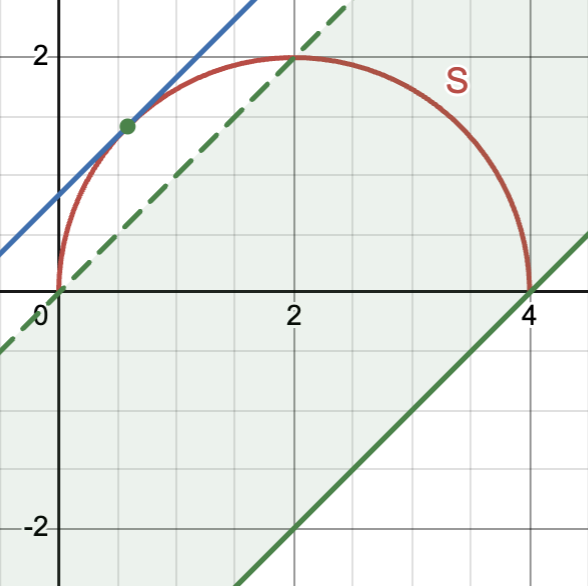
Some pretty straight forward alegbra yields the blue line as $y=2\sqrt{2}-2+x$ and the green region as $x-4\le y<x$. Thus we have $(m,n,p,q)=(-4,0,8,2)$, and the requested sum is $\boxed{\text{(D) }6}$. $\square$
Problem 18
We consider two cells to be adjacent if they share an edge. For instance, in the following array,
\[\begin{bmatrix}1 & 2 & 3\\4 & 5 & 6\\7 & 8 & 9\end{bmatrix}\]Cells 1 and 2 are adjacent, but cells 5 and 9 are not.
Now, let $S_0$ be a $3\times3$ array with 3 entries as 1 and the rest as 0.
Suppose that in a process called a step, we construct array $S_1$ according to the following rules:
- If at least two of the four cells adjacent to a cell labeled 0 are labled 1, then that cell becomes a 1
- Otherwise, it stays a 0
An example is shown below:
\[\begin{array}{cc} S_0 & S_1 \\ \begin{bmatrix}1&0&0\\1&0&0\\0&1&0\end{bmatrix} & \begin{bmatrix}1&0&0\\1&1&0\\1&1&0\end{bmatrix} \end{array}\]We continue constructing arrays $S_2, S_3,\dots$ in a similar fashion until $S_i=S_{i-1}$ for some integer $i$ (i.e. no more changes can be made). For how many starting $S_0$ (with three entries 1) will $S_i$ be the array consisting of only 1’s?
\[\begin{bmatrix}1&1&1\\1&1&1\\1&1&1\end{bmatrix}\]$\text{(A) 2} \qquad \text{(B) 4} \qquad \text{(C) 6} \qquad \text{(D) 10} \qquad \text{(E) 14} $
Solution: This is probably the hardest problem on this test. Observe that if any of rows 1, 3, columns 1, 3 do not contain a 1, they will stay 0 forever (this does not apply to the center row and column because they can become filled if their left/right or top/bottom neighbors are both 1). In particular, these are the only rotationally distinct solutions:
\[\begin{array}{cccc} \begin{bmatrix}1&0&0\\0&1&0\\0&0&1\end{bmatrix} & \begin{bmatrix}1&0&1\\0&0&0\\0&1&0\end{bmatrix} & \begin{bmatrix}1&0&1\\0&0&0\\1&0&0\end{bmatrix} & \begin{bmatrix}1&0&0\\0&0&1\\0&1&0\end{bmatrix} \end{array}\]which collapse in these ways:
\[\begin{array}{cccc} \begin{bmatrix}1&0&0\\0&1&0\\0&0&1\end{bmatrix} & \begin{bmatrix}1&0&1\\0&0&0\\0&1&0\end{bmatrix} & \begin{bmatrix}1&0&1\\0&0&0\\1&0&0\end{bmatrix} & \begin{bmatrix}1&0&0\\0&0&1\\0&1&0\end{bmatrix}\\ \begin{bmatrix}1&1&0\\1&1&1\\0&1&1\end{bmatrix} & \begin{bmatrix}1&1&1\\0&0&0\\0&1&0\end{bmatrix} & \begin{bmatrix}1&1&1\\1&0&0\\1&0&0\end{bmatrix} & \begin{bmatrix}1&0&0\\0&1&1\\0&1&1\end{bmatrix}\\ \begin{bmatrix}1&1&1\\1&1&1\\1&1&1\end{bmatrix} & \begin{bmatrix}1&1&1\\0&1&0\\0&1&0\end{bmatrix} & \begin{bmatrix}1&1&1\\1&1&0\\1&0&0\end{bmatrix} & \begin{bmatrix}1&1&0\\1&1&1\\0&1&1\end{bmatrix}\\ & \begin{bmatrix}1&1&1\\1&1&1\\0&1&0\end{bmatrix} & \begin{bmatrix}1&1&1\\1&1&1\\1&1&0\end{bmatrix} & \begin{bmatrix}1&1&1\\1&1&1\\1&1&1\end{bmatrix}\\ & \begin{bmatrix}1&1&1\\1&1&1\\1&1&1\end{bmatrix} & \begin{bmatrix}1&1&1\\1&1&1\\1&1&1\end{bmatrix} & \end{array}\]Summing their rotational orders gives $2+4+4+4=\boxed{\text{(E) } 14}$.
Problem 19
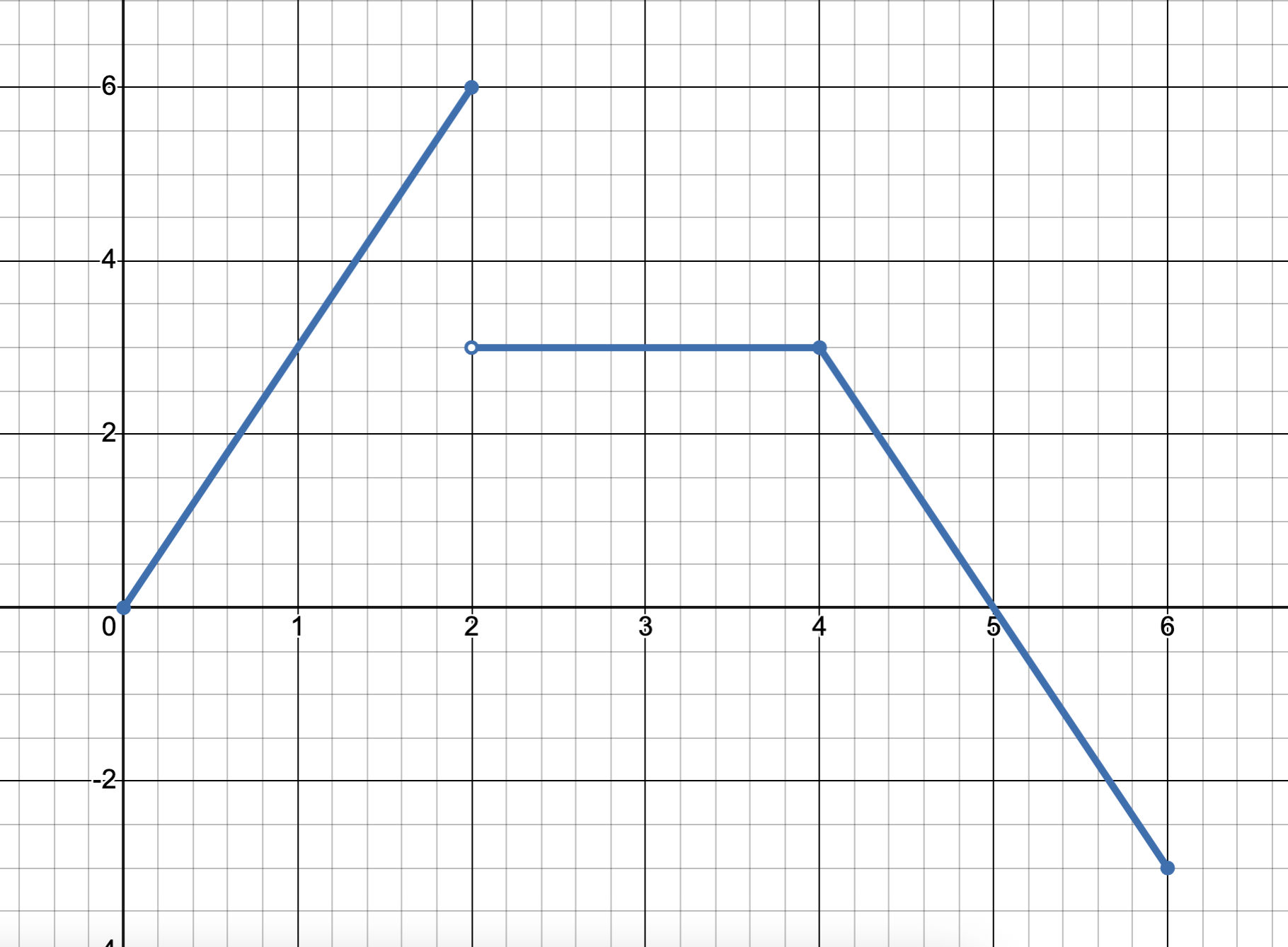
The graph of $y=f(x)$ is shown. The sum of the real solutions of $f(f(f(x)))=0$ is
$\text{(A) } 0\qquad \text{(B) } 5\qquad \text{(C) } \dfrac{20}{3}\qquad \text{(D) } \dfrac{35}{3}\qquad \text{(E) } \dfrac{65}{9}$
Solution: Observe that $f$ is composed of 3 parts: $y=3x$ on $[0,2)$, $y=2$ on $[2,4)$, and $y=-3(x-5)$ on $[4,6]$. Now first let $f(f(x))=a$: then $f(a)=0\Longrightarrow a=0,5$. Similarly letting, $f(x)=b$, we have $f(b)=0,5\Longrightarrow b=0,5,\frac{5}{3}$. Finally, solving $f(x)=0,5,\frac{5}{3}$, we get $x=0,5,\frac{5}{3},\frac{5}{9},\frac{40}{9}$, so the sum will be $\boxed{\text{(D) } \frac{35}{3}}$.
Problem 20
The graph of $\left(\left\vert y-2x\right\vert-0.5\right)\left(\left\vert x-2y\right\vert-0.5\right)=0$ splits the coordinate plane into 9 distinct regions; exactly one of these has a finite area of $A$. Find $A$.
$\text{(A) } \dfrac{1}{3}\qquad \text{(B) } \dfrac{4\sqrt2}{3}\qquad \text{(C) } \dfrac{2}{3}\qquad \text{(D) } \dfrac{2\sqrt2}{3}\qquad \text{(E) } \dfrac{4}{5}$
Solution: Let us first figure out what this equation looks like. The zero product rule implies that either $\vert y-2x\vert =0.5$ or $\vert x-2y\vert=0.5 $. These in turn imply the relations $y=2x\pm0.5$ and $y=\frac{1}{2}x\pm0.25$. Graphing these lines, we see that the finite region centered at $(0,0)$ is in fact a rhombus with diagonals of lengths $\sqrt{2}$ and $\frac{\sqrt{2}}{3}$, so the area will be $\frac{1}{2}\cdot\sqrt{2}\cdot\frac{1}{3}\sqrt{2}=\boxed{\text{(A) } \frac{1}{3}}$. $\square$
Problem 21
Rectangle $ABCD$ has $AB=2$ and $BC=1$. Circle $\omega$ passes through $A$, $D$, and the midpoints of $AB$ and $CD$. Diagonal $AC$ intersects $\omega$ at point $P$. Find the area of triangle $ADP$.
$\text{(A) } \dfrac{1}{3}\qquad \text{(B) } \dfrac{2}{5}\qquad \text{(C) } \dfrac{1}{2}\qquad \text{(D) } \dfrac{3}{5}\qquad \text{(E) } \dfrac{2}{3}$
Solution: Let $M$ be the midpoint of $CD$. By the Power of a Point on point $C$ with respect to $\omega$, we find $CP\cdot CA=CM\cdot CD\Longrightarrow \sqrt5\cdot CP=1\cdot2 \Longrightarrow CP=\frac{2}{\sqrt5}$. Thus, $AP:CA=3:5$, so $[ADP]=\frac{3}{5}\cdot[ADC]=\boxed{\text{(D) } \dfrac{3}{5}}$. $\square$
Problem 22
Let the four roots of the equation $x^4+x^3+4x^2+2x+4=6x^2$ be $r_1,r_2,r_3,r_4$. Find the value of:
\[\left(r_1+\frac{2}{r_1}\right)+\left(r_2+\frac{2}{r_2}\right)+\left(r_3+\frac{2}{r_3}\right)+\left(r_4+\frac{2}{r_4}\right)\]$\text{(A) } -4\qquad \text{(B) } -2\qquad \text{(C) } -1\qquad \text{(D) } 1\qquad \text{(E) } 2$
Solution 1: Intended. Evidently 0 is not a root. So divide the equation by $x^2$ to obtain $x^2+x+4+\frac{2}{x}+\frac{4}{x^2}=6.$ Now let $u=x+\frac{2}{x}$; note that $u^2=x^2+4+\frac{4}{x^2}$. Then the equation becomes $u^2+u=6$, so $u=2,-3$. Since each $u$ contributes $2$ solutions for $x$, the sum of the $\left(r_1+\frac{2}{r_1}\right)$’s is just $2(2-3)=\boxed{\text{(B) } -2}$. $\square$
Solution 2: Vieta cheese. Moving the $6x^2$ to the LHS yields $x^4+x^3-2x^2+2x+4=0$. The desired formula can be rewriten as $(r_1+r_2+r_3+r_4)+2\left[\frac{r_1r_2r_3+r_2r_3r_4+r_3r_4r_1+r_4r_1r_2}{r_1r_2r_3r_4}\right]$, which is equal by Vieta to $-1+2\cdot\frac{-2}{4}=\boxed{\text{(B) } -2}$. $\square$
Problem 23
The last two digits (from the left) of $11^{2026}$ are:
$\text{(A) } 01\qquad \text{(B) } 11\qquad \text{(C) } 21\qquad \text{(D) } 41\qquad \text{(E) } 61$
Solution: We have by the Binomial Theorem $11^{2026}=(10+1)^{2026}=1+2026\cdot 10+\binom{2026}{2}\cdot10^2+\dots+10^{2026}$. Since we seek only the last two digits (tens and units) we can ignore everything that contains two or more factors of 10 (since these will end in at least 2 zeroes). Thus, the last two digits are simply those of $2026\cdot10+1$, which are $\boxed{\text{(E) } 61}$. $\square$
Problem 24
There exists a unique postive integer value of $n$ such that, in degrees, the interior angle measure of a regular $(n-1)$-gon is $6^\circ$ less than the interior angle measure of a regular $(n+1)$-gon. Find $n$.
$\text{(A) } 7\qquad \text{(B) } 9\qquad \text{(C) } 11\qquad \text{(D) } 13\qquad \text{(E) } 15$
Solution: The interior angle measure of a regular polygon with $k$ sides is given by $180\cdot\frac{k-2}{k}$. Therfore, we seek the integer $n$ such that $180\cdot\frac{n-3}{n-1}-180\cdot\frac{n-1}{n+1}=6$. This simplifies to $30 \left( \frac{n - 1}{n + 1} - \frac{n - 3}{n - 1} \right) = 1$, which is actually equivalent to $30 \left( \frac{4}{n^2 - 1} \right) = 1$. Finally, rearranging yields $n^2=121$ so $n=\boxed{\text{(C) } 11}$. $\blacksquare$